

The forever bottleneck, part 2
The M4 in West London may have been bold and innovative, but if you've never built a motorway before you're bound to make some mistakes.

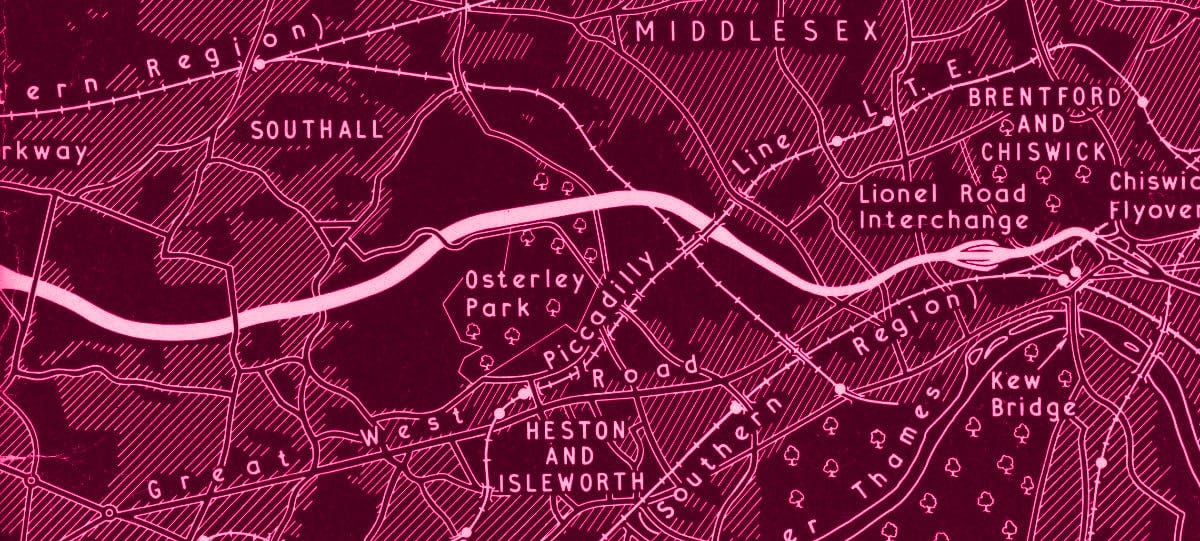
This is the second of two posts looking at the M4 between Chiswick and Langley - opened in 1965 to great fanfare, and almost instantly regretted because of the fatal and unfixable bottleneck built into its design.
Part 1 explored the experiments packed in to this 11-mile project. This part asks why exactly a three-lane motorway narrows down to two lanes on the final approach to Europe’s biggest city. What was the thinking that gave us a lifetime of daily traffic jams?
The answer involves engineers who had never designed a motorway before, a government Ministry that wasn't asking the right questions, and a project that was so full of experiments that one of its bold new ideas was bound to backfire. And the story begins in the 1950s.
New lines
After the Second World War, the Ministry of Transport started drawing up plans for a future motorway network, and one of their ambitions was to link London with South Wales. In 1956 the Government announced that this would be among the first new routes to be built.
To get it started quickly, some existing projects were drafted in.
For example, the first sections of the M4 to open were the Maidenhead Bypass (1961) and the Slough Bypass (1963); that’s because they were pre-war projects that were put on ice at the outbreak of hostilities. Maidenhead even had part-completed bridges and embankments when the bulldozers arrived to build the M4 in 19581.
Within London, the Ministry was improving the A4: widening Talgarth Road and Cromwell Road, and building the Chiswick Flyover (1959) and Hammersmith Flyover (1961).
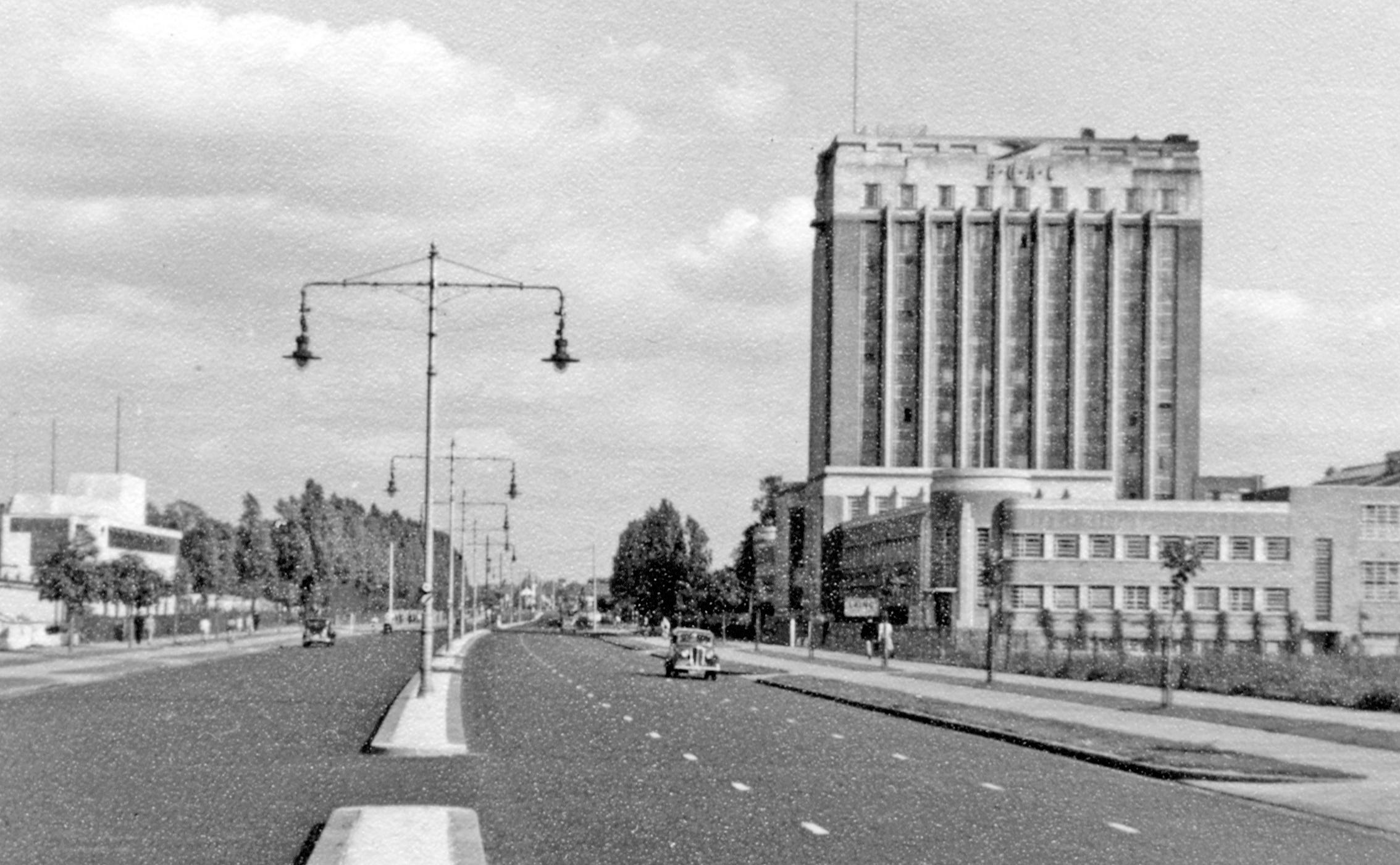
That left a gap between Chiswick and Slough. The A4 had been improved here - the Great West Road was one of the very first new roads built in London, completed in 1925; Colnbrook had also been bypassed soon afterwards. But the 1920s arterial road was lined with factories and houses, so it couldn’t be part of the new motorway to Wales, and it was struggling to serve the brand new London Airport, recently opened at a place called Heathrow.
So, with no existing project to borrow, something new was required from Chiswick to Langley. This section would form the easternmost part of the new motorway and connect London to its new airport.
The Ministry was planning a lot of motorways at this time, and had neither the staff nor the experience in-house to design them all, so it outsourced the difficult ones to consulting engineers.
Sir Alexander Gibb and Partners won the contract to design the M4 between Chiswick and Langley. In 1956 they sharpened their pencils and got to work.
Up in the air
The consultants’ first Engineering Report was issued in November 19572, outlining the available options.
The concept of a motorway was so new (the UK’s first one was still under construction) that the report spent some time discussing whether it might be a single carriageway with three lanes, providing one lane in each direction and a third in the middle for overtaking3. Thankfully this was quickly dismissed: it would lead to “dangerous overtaking” on a high speed road, and would be “regretted in a very few years”.
Through Brentford, the new road would have to be suspended above the existing A4 - there was no other suitable way to connect to the new Chiswick Flyover. Initially, the plan was to then continue above the A4 all the way to Langley, effectively double-decking the existing road. This had the advantage of needing very little new land and passing close to Heathrow.
The expense of building such a long double-deck structure, the effect on the many houses and buildings that lined the A4, and the occasional uncomfortably sharp turns it would have to negotiate, all ruled that out.
Instead, the engineers sent the M4 through vacant land - gravel workings around Harmondsworth; the remnants of Heston Aerodrome; and the grounds of Osterley Park which had, usefully, been transferred to the Ministry of Works in 1947 - before mounting a viaduct for the short but difficult bit past Brentford to Chiswick.
Three’s a crowd
By November 1958 the route was settled, as was the design for the viaduct above the Great West Road. It would be supported on a row of piers in the central reservation, with the deck cantilevered out to each side – essentially the structure that was built.
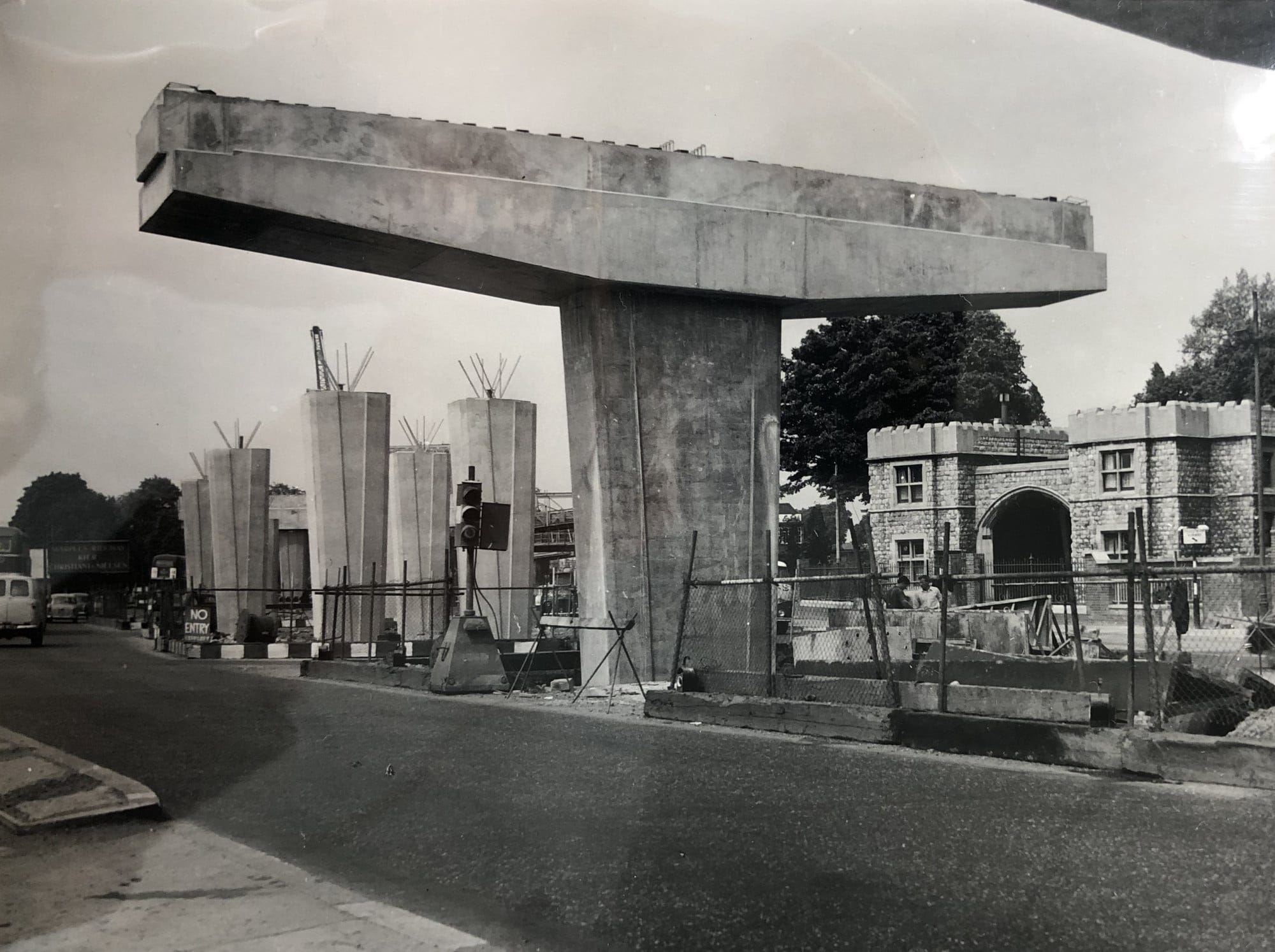
The consultants recommended two lanes each way on the viaduct, but the Ministry’s engineers weren’t yet convinced, and questioned this point repeatedly. On 19 November 1958, Mr JDW Jeffery spoke to Gibb and Partners, and later wrote up his findings for the benefit of his colleagues:
“I have again this morning spoken to the consulting engineers about the additional cost of providing dual three lane carriageways on the viaduct and they confirm the previous figure of £2M. to £2½M. as the additional cost…”4
It had been explained to him that a “more normal portal frame” structure - two lines of pillars, one on each side - would only cost £½m more, but its foundations would be in the verges of the Great West Road, meaning gas pipes, water pipes and electricity cables would have to move, costing upwards of £½m.
Besides, he was warned, while building it there would be huge difficulty in keeping the Great West Road open for traffic.
Gibb and Partners’ recommended design - supports down the middle, and just four lanes on top - could be built while keeping four traffic lanes open on the Great West Road. And keeping it open was the Ministry of Transport’s biggest worry.
Intense agony
The A4 Great West Road was one of London’s main arterial roads, and it hosted a large number of prestigious industrial premises, for which it was the only means of access. Plus, in the 1960s, roads rarely closed for construction work - the Queen’s Highway had to remain open and the traffic had to continue flowing.
Building the M4 viaduct above the Great West Road was bound to be disruptive. Worse still, the viaduct had to be joined to the brand new Chiswick Flyover, meaning the flyover had to be closed for four months while its western ramp was demolished and replaced.
To gauge the level of disruption this would cause, on Monday 25 September 1961 the Ministry carried out an “experimental closure” of the flyover. Through traffic was returned to the Chiswick Roundabout. The flyover had only been open for two years so this should not have been calamitous.
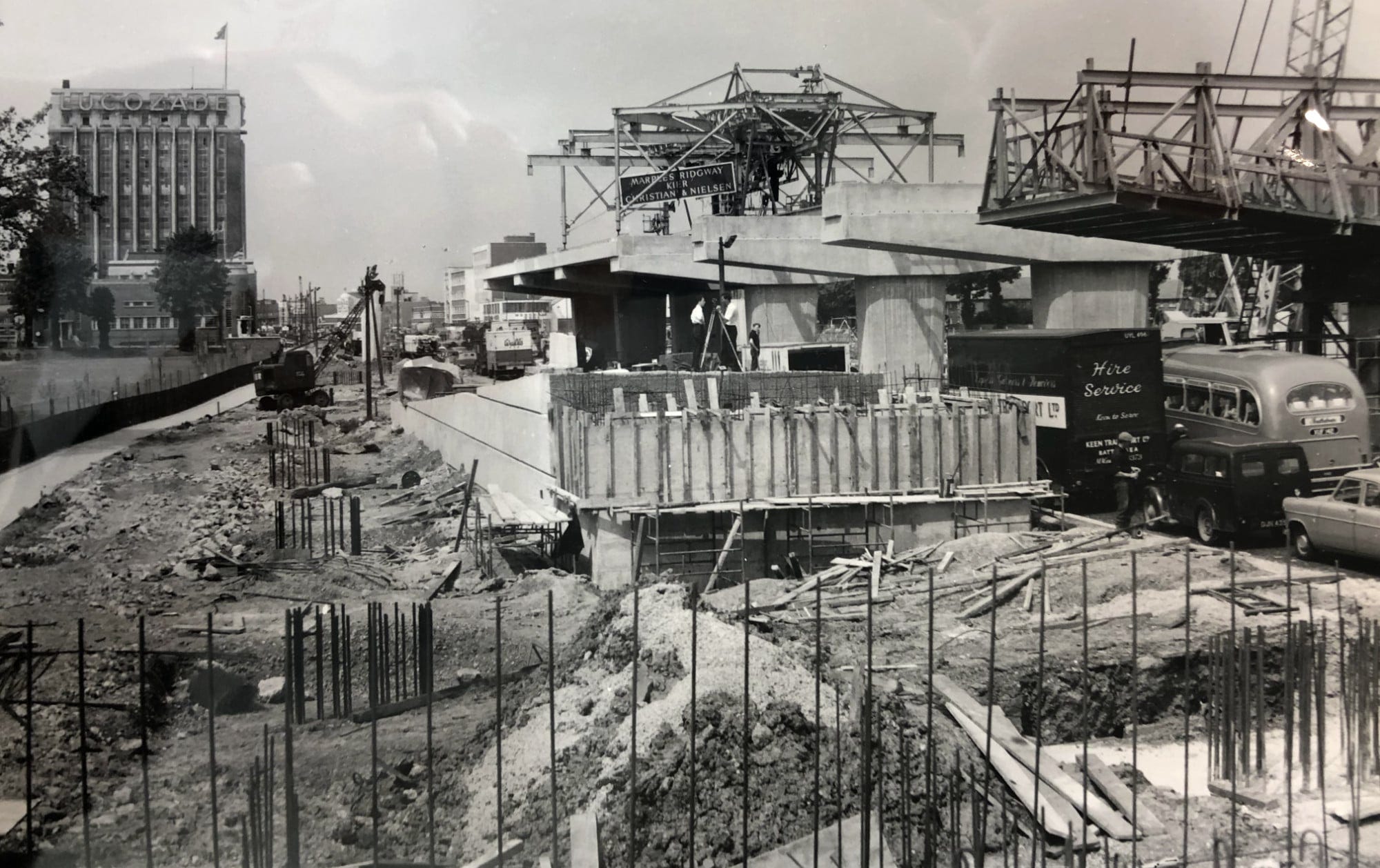
The Guardian reported on this event with a degree of alarm that was mirrored across the rest of the press. There were tailbacks of “bank holiday proportions”. Their reporter on the scene described the ensuing congestion as “intense agony”.
When the time came for the flyover to be closed for real, the Ministry of Transport’s Press Office was in a state of heightened anxiety. Motorists were sternly instructed to avoid the A4 entirely; the doom-laden publicity campaign repeatedly used the slogan DON’T GO WEST5.
The experiment only confirmed the Ministry’s fears. Before the motorway was under construction, and before the Chiswick Flyover had ever opened to traffic, keeping the A4 moving through the roadworks came above all other concerns.
Three into two won’t go
On 21 November 1958, in one of the Ministry of Transport’s countless meeting rooms at Berkeley Square House in Mayfair, representatives from Gibb and Partners arrived for their routine progress meeting. Just two days earlier, Mr Jeffery had asked them about putting three lanes each way on the viaduct, and they had ruled it out. Now the Ministry’s engineers were asking again.
The senior representative from Gibb and Partners was Mr Lander, and Mr Lander had come prepared. Perhaps understanding that the question had still not been put to bed, he presented a whole new set of options for providing three lanes each way on the viaduct, and then patiently explained why each of them was more difficult, more expensive, pushed the motorway closer to adjoining buildings, and incurred unknown costs in the relocation of utilities.
And with all of them, he said, there came the same extra problem: keeping the Great West Road open while you built one of these monumentally ugly structures.
That would probably have been enough, but he then landed his final flourish, recorded in the minutes like this.
“Mr. Lander reminded the meeting that a decrease to dual 24ft. carriageways was inevitable at the Chiswick Flyover, which had been built, and he wondered what was being gained.”6
The brand new Chiswick Flyover had two lanes each way. Why provide a three lane viaduct if you had to narrow it down again for the last 400 metres?
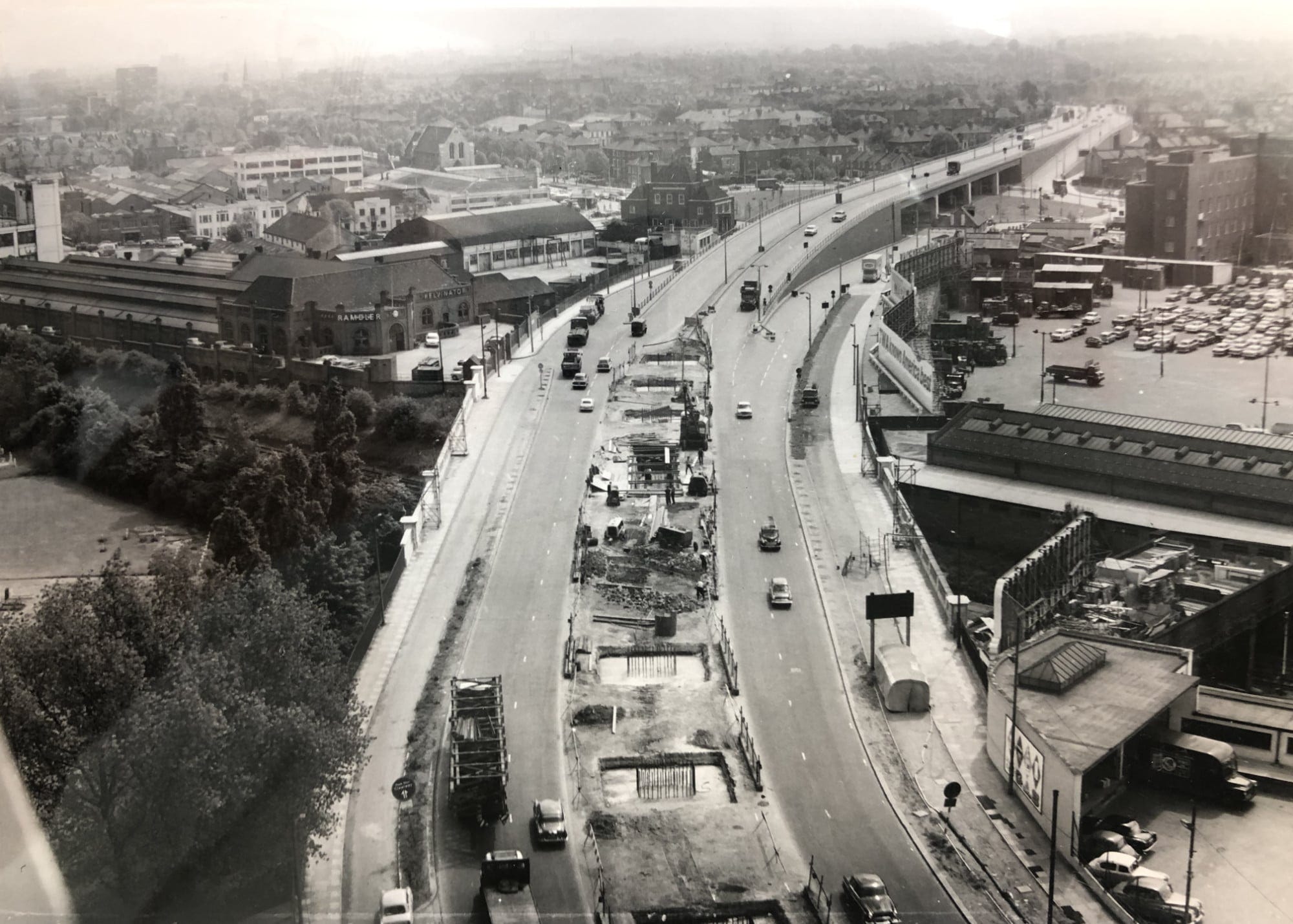
The Ministry was finally convinced. The minutes record that, “despite the agitation” for three lanes each way, the viaduct would carry two.
21 November 1958 was the day that occupants of a small meeting room in Mayfair determined the fate of London’s motorists for all time, fixing in the design of the M4 the bottleneck between junctions 3 and 27.
But why was the M4 three lanes wide in the first place?
Running the numbers
In December 1960, another internal memo fluttered across desks at the Ministry’s headquarters, written by civil servant LS Mills. It dealt with the question of how wide the M4 needed to be between the airport (J4) and Langley (J5)8.
Traffic estimates suggested three lanes were required to the airport, but only two lanes could be justified from there to Langley. The Slough and Maidenhead Bypasses - then under construction - were only two lanes wide, so the third lane couldn’t go beyond Langley no matter what.
It might seem obvious that a motorway where two lanes were required, leading to another section with two lanes, ought to have two lanes. The memo began by confirming that this would be “logical”.
But Mr Mills was thinking of something other than logic. On the basis that three lanes made for “freer movement of traffic”, and that this was an approach to London, he wanted approval to spend an extra £400,000 to provide a third lane anyway. “I think,” he wrote, “this is a case where we should be fully justified in over-providing for the future.”
He wasn’t wrong: the M4 west of the airport is among the busiest motorways in the London area; it’s been widened more than once, and a two-lane motorway would have been sorely regretted, as the Slough and Maidenhead Bypasses both were. The point is not that Mr Mills was mistaken, but that there could be such a striking double standard at play on this relatively short project.
West of the airport, only two lanes could be justified, but three were built. East of the airport, three lanes were plainly needed, but the motorway would narrow to two lanes anyway.
This was not a design led by hard-nosed evidence. There wasn’t much of that about, so it was a design borne of inexperience. And, perhaps most importantly, it was a design produced for a client who didn’t understand the project. The Ministry’s engineers weren’t equipped to ask the right questions. Up against Mr Lander with his detailed presentation, they could ask if the viaduct could have a third lane, but when he said no, they had no arguments of their own.
Nobody asked whether the third lane could be dropped more elegantly by having it exit the motorway - at Lionel Road, maybe, where lots of traffic exits for the North and South Circulars, or at Cranford, or by inserting another junction at Osterley.
And nobody knew whether narrowing the motorway from three lanes to two would actually work.
Where the rubber hits the road
By 1960, the viaduct was described as having only two lanes for reasons of cost, even though this wasn’t the reason a third lane had been ruled out. But the Ministry’s engineers were now talking with some confidence about how this would work.
LS Mills explained it in his memo:
“Because of the high cost, the viaduct has to be two-lane, but we are proposing to increase its capacity by imposing a speed limit.”
If you’ve ever driven the M4 viaduct you will be surprised that anyone ever thought it might have no speed limit, but that was initially the idea9. The fact that it opened with a 50mph limit was not for safety but for capacity.
Their idea was this. Vehicles travelling at high speed maintain long headways. This means each vehicle occupies a lot of physical space (the length of the vehicle plus the long gap between it and the next one). That, plus the speed, dictate the capacity of each traffic lane.
Vehicles travelling at a lower speed can have shorter headways, travelling closer together, requiring less space per vehicle, making room for more vehicles to get through in the same amount of time.
In theory it works. In theory the traffic on a three-lane motorway moving at 70mph can be accommodated on a two-lane motorway at lower speeds.
In practice, things are much less tidy.
In practice, vehicles approach the transition point at different speeds, and slow down at different rates, and have to physically merge into fewer lanes, all of which causes turbulence in the stream of vehicles. As soon as someone taps their brakes to allow another vehicle to come in, there’s a risk of others behind braking. These little things are the seeds of congestion.
But in 1960, nobody had ever tried it. The Ministry was still beholden to their consultants, and their consultants were working only with a theory10.
In theory, there was no bottleneck.
The big experiment
The M4 between Chiswick and Langley was one big experiment. The numerous trials in road surfacing, construction techniques, heating, signalling and more were listed in part 1, but they were only really the start.
Not only were its designers still learning how to design a motorway, they were learning how to do it before one had yet been built, and they were playing this game on the hardest setting - coming up with a way of building an elevated road while, underneath, traffic flowed along one of London’s most important roads.
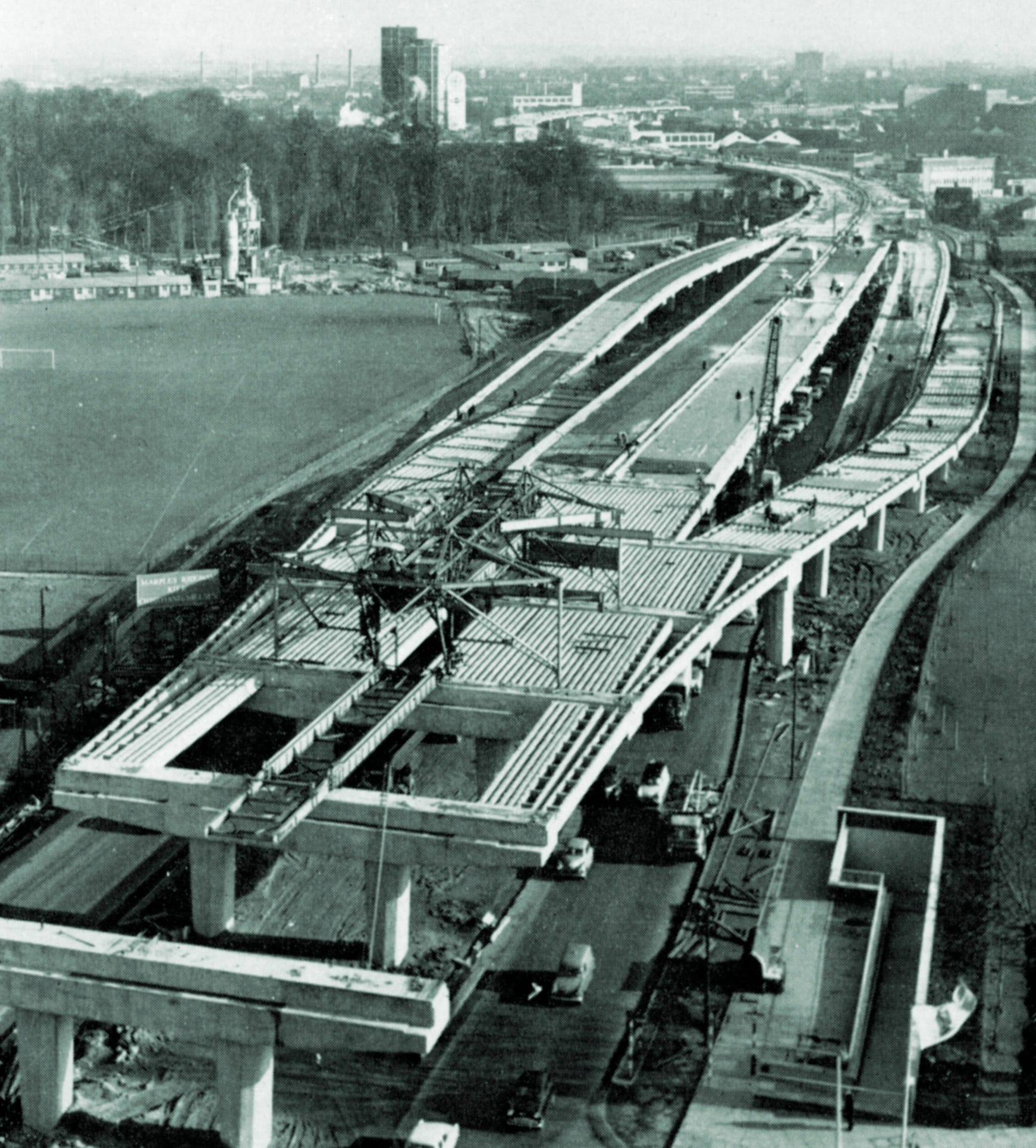
It’s no great surprise, when so many new things were being tried, that something would go wrong. It would be easy to look back with the benefit of hindsight and curse Mr Lander, and all his kind, for building into this project such a catastrophic failure, one that would be the cause of chronic congestion on a daily basis for decades to come, one that couldn’t then be fixed.
But the road to Slough is paved with good intentions. The designers of the M4 were doing their best, working without practical experience because there was none to be had. Perhaps the more astonishing thing is that they got so much of it right.
The road surface could have broken up in its first winter. The junctions could have been laid out with unforeseen dangers. There could have been catastrophic consequences if the viaduct, with its new materials and experimental techniques, hadn’t been flawlessly designed and built with great care. But none of that happened. For the most part, their theories were right.
The only reminder of their experimentation - the only sign that, to its designers, a motorway was not mundane, ubiquitous or subject to a detailed design manual, as it would be today - is the bottleneck. The one that didn’t exist in theory, but turned up almost immediately in practice. The one that has come to define the London end of the M4. The forever bottleneck.

You can see the full commemorative booklet published to celebrate the opening of the M4 between Chiswick and Langley over on the website.
Next time: Q&A
I’d like to try something new in the next few weeks - a Q&A to answer questions you might have. If it goes well I’d like to do them regularly, perhaps on different topics each time.
This first one won’t be tied to a single topic. If you have a road-related question you’d like me to answer, drop it in the comments below or send me message.
Picture credits
Photograph of Great West Road in 1949 is taken from an original by Ben Brooksbank and used under this Creative Commons licence.
This is also why the M4 between junctions 5 and 9 opened with only two lanes each way, and why the hard shoulder didn’t fit under the bridges after it was widened in the 1970s, and why all the bridges had to be replaced for the Smart Motorway project a few years back, making it so fabulously slow and expensive.
Three-lane single carriageways like this are almost unknown now, but were a common standard for rural trunk roads from the 1930s to the 1970s. The bi-directional central overtaking lane was precisely as unsafe as it sounds.
All recorded at MT 121/135. There is also the complete text of the story’s coverage in The Daily Worker, which was plainly not very interested. Their report read, in its entirety, “Chiswick flyover on the Great West Road will be closed for three to for months while it is connected with the London-South Wales motorway. iushlcsSgooew-”.
Minutes of a meeting held 21 November 1958 between representatives of Sir Alexander Gibb and Partners and the Ministry of Transport, held at MT 95/309.
It was exactly two weeks before the UK’s first motorway, the Preston Bypass, opened to traffic.
Minute from LS Mills, 12 December 1960, at document 46A, MT 121/135.
When this project opened, motorways didn’t have speed limits - the national 70mph limit arrived nine months later.
By 1980, we had tried it, in several places, and found every time that it didn’t work, and yet we still thought it might work OK where the M25 goes through the Dartford Tunnels. It didn’t work. We don’t think it works any more.