

The forever bottleneck, part 1
The M4 into London was one of the UK's earliest and most ambitious motorway projects. It was bold, pioneering... and almost instantly regretted.

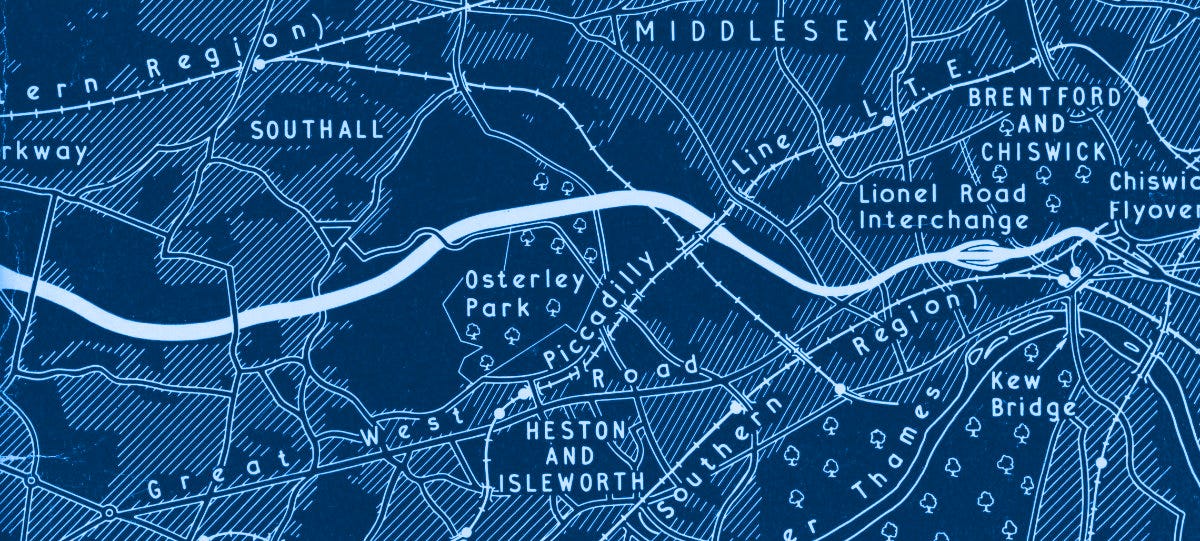
If you’re familiar with the M4 in West London, you’ll know only too well the narrow viaduct at Brentford. A three-lane motorway narrows to two lanes on the way in to London, resulting in a near-permanent traffic jam.
Just arrived, over on the website, is the complete booklet published in 1964 to mark the opening of this section of motorway, which ran from Chiswick to Langley (J1-5). It’s the latest addition to my collection of these commemorative publications.
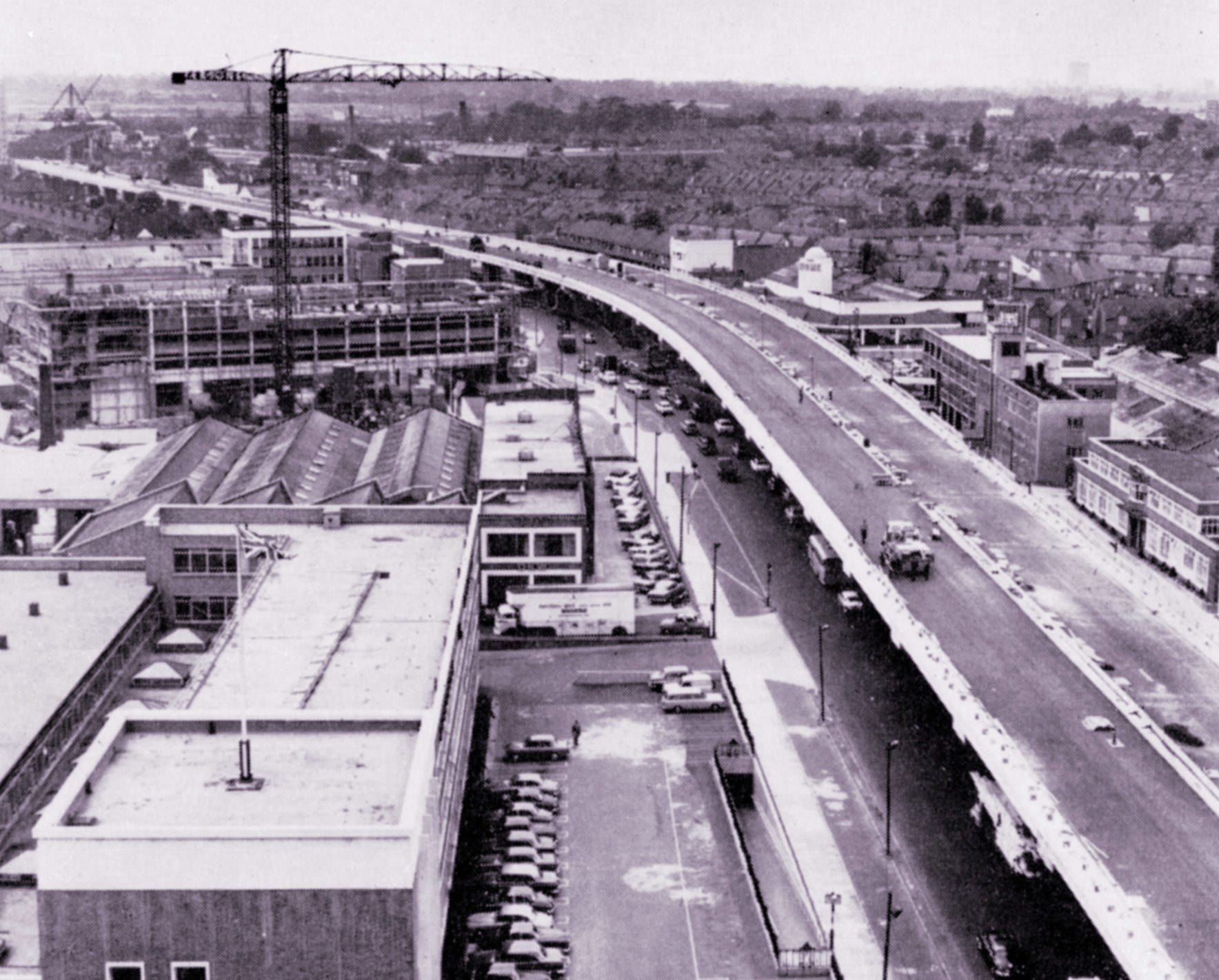
Like all these booklets, it’s a fascinating window into another world. It offers photographs of the motorway under construction - including, most notably, that long elevated viaduct above the Great West Road through Brentford.
The book is understandably very proud of this feature: it was completely unique in the UK when it first opened, and considered a real achievement, not least since it had been built while traffic continued to flow on the A4 underneath. But that pride didn’t last long. Just eight years after it opened, the panel of the Layfield Inquiry1 described it like this:
“Present traffic on this road clearly demonstrates…the inadequacy of the dual 2 lane elevated section in the Chiswick/Brentford area. [The Ministry of Transport] gave evidence which indicated that widening of the present elevated road, either elevated or at ground level, was not possible within limits of conceivable expenditure.”2
Because this brand-new road was already a problem, and the problem could not be solved, the panel had to conclude:
“It is clear that the M4 will have to be included in the primary principal road network, but clear also that every effort must be made to reduce or reroute some of the traffic it now carries…”3
Within a decade of opening, planners wanted to encourage traffic away from the M4, thanks to a design flaw that could not be fixed. Something had gone very wrong.
As traffic levels rose, the problem only got worse. Today, the elevated section of the M4 has been a bottleneck for 60 long years, and is now a maintenance liability as well, with regular closures for inspections and repairs, and netting strung underneath in case lumps of concrete fall off4.
How did London end up with such a complete mistake - and what were its designers thinking?
We’ll find some answers in this two-part post. The design process that gave us the fatal bottleneck will follow in part two, but we’ll start today with a look at just how thrillingly novel the M4 between Chiswick and Langley was.
The special road
One thing the booklet reminds us - not just from the date on its cover, but also in the way it talks about the project - is how early this came in the UK’s motorway programme. It is described in the booklet, as many early motorways were, by its legal name - the “Chiswick-Langley Special Road”5. It was a very early motorway project.
The first steps to build it started in 1961, and main construction got under way at the end of 1962. At that time, the UK’s first experimental motorway had only been open for about four years. Perhaps more importantly, the length of time it takes to design a road project and get it to the point where it’s approved and funded meant that this project was designed before the first motorway had opened.
You might think that, by the early 1960s, we would know how to build and surface a road. We’d been doing it for decades. But motorways were a new phenomenon, with heavier, faster traffic. They called for more bridges, more earthworks, better alignments - more and better everything, in fact, than any road that came before.
Engineers had to learn how to make a new kind of road, and the Ministry wanted to be good at it because the motorway programme was huge. 1,000 miles had to be delivered in the space of a decade, so lessons had to be learned, fast, all the time6. In the end, by the time they’d mastered it, we’d pretty much built the motorway network and construction began to slow.
So, when designs for the M4 between Chiswick and Langley were finalised, no motorways yet existed. When spades hit the ground, no other motorways were urban or elevated, and only a handful of routes had opened at all (as shown on this map). Not only had the Ministry of Transport never built a motorway like this before, it had very little real-world experience of building or operating motorways at all.
And so, five years in to the UK’s first thousand-mile motorway programme, the M4 between Chiswick and Langley was one big experiment.
New foundations
When you build a major new road, the ideal situation is that the amount of earth you excavate and the amount you pile up for embankments is about the same, so you don’t need to import or dispose of vast quantities of it. Unfortunately the M4 did not present this opportunity - most of the motorway was on embankment, with very little cutting, so large amounts of material had to be found and brought on site.
I’ve written before about how one unlikely source of earth was Hyde Park, where the creation of an underground car park generated half a million tons of spoil that could be transported to Osterley and piled up to form a motorway.
But earth is hard to come by, so the Ministry went looking for other materials that might be useful. They found it a few miles away in the form of a rubbish tip. Just east of junction 3, the motorway embankment is made from “domestic refuse”.
During the early twentieth century, the bins of North London were emptied and their contents sent by canal barge to be dumped on Hounslow Heath. By the 1960s, most of this had rotted down, leaving mostly coal ash, which was inert and stable when piled up. A million tons of this household waste now support the M4 around Heston Services.
New surfaces
The booklet is full of arcane detail about the road - satisfying, you have to assume, the curiosity of industry insiders attending the opening ceremony, who might be genuinely interested to know how many cubic yards of concrete were used in contract 3 to form the road slab (99,000) or how many rubber bearings were required for the viaduct (8,984).
Of greater historical interest are the detailed accounts of the experiments the Ministry conducted into road surfacing.
Apart from the lengthy viaduct, most of the new motorway had a concrete surface7, since that was considered economical to build and maintain. But part of it was built differently with the specific intention that it would be a test ground.
Between junctions 4 and 5, seven different kinds of tarmac surface were built so that the Road Research Laboratory could evaluate their performance. Different combinations of stone, binder, surface thickness and sub-base depth were employed, enabling the Ministry’s scientists to compare how they held up under sustained heavy traffic loads.
Even white lines were part of the experiment. While lane markings were formed using thermoplastic paint, as they are now, the Ministry was still searching for a durable and visible way to mark the hard shoulder8. Nine different ways to form a white line were tried, including concrete blocks, plastic tiles and white paint with flint chippings.
New structures
The centrepiece of the project was the huge viaduct at Brentford. Nothing like it had ever been built in the UK. It was in two parts, and both were novel.
The concrete section was peculiar because it was constructed above the A4 Great West Road. Today, major roadworks (and even some fairly minor, routine roadworks) often entail full road closures for the safety of workers and the public, sometimes for prolonged periods. But in the 1960s that was unthinkable - the traffic could not be stopped - so the viaduct had to be built above a busy road.
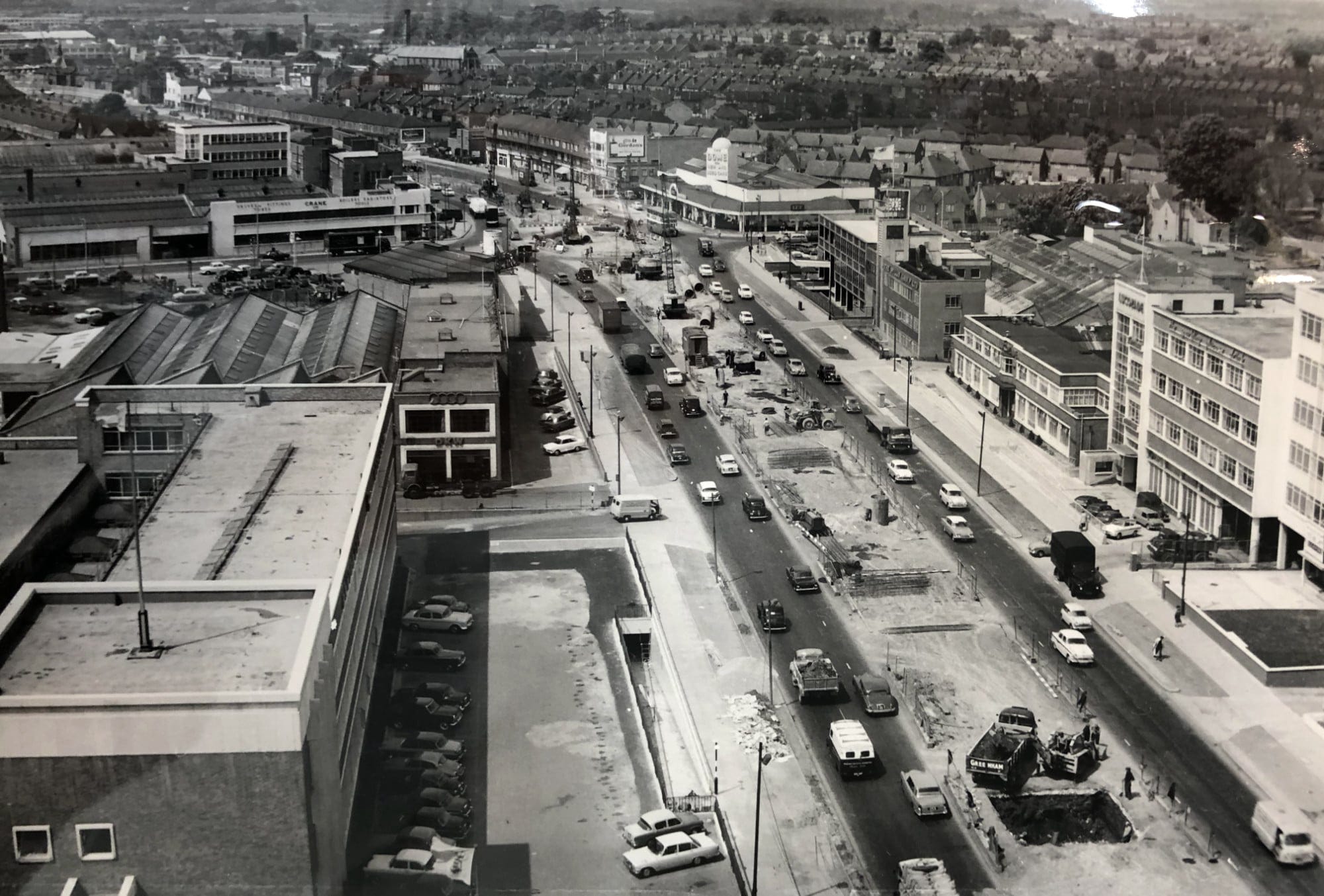
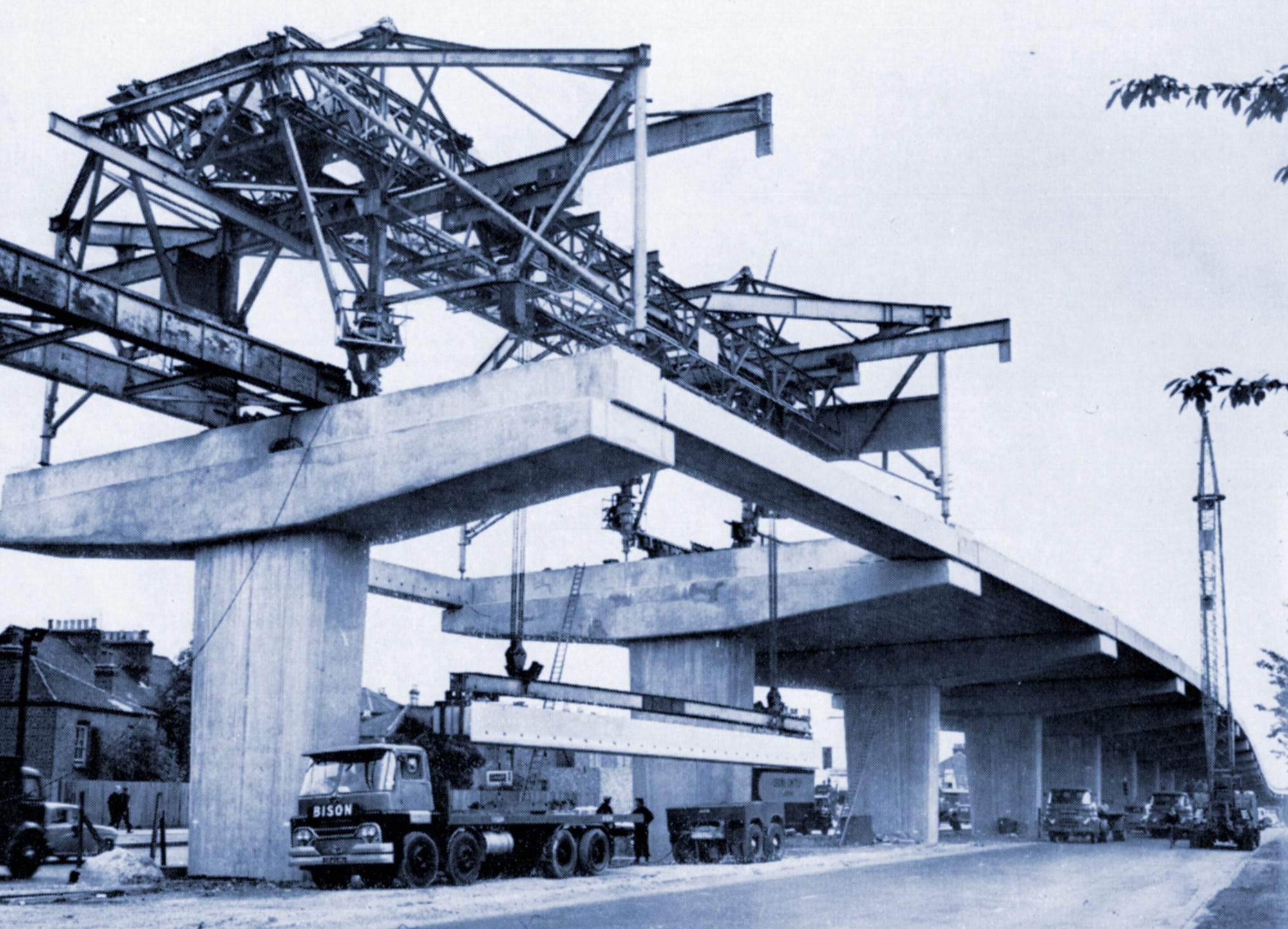
Three lanes of road were reduced to two in each direction to make space. In the middle of the A4, boreholes 1.2m in diameter were drilled more than 15m down to support the structure. Concrete pillars had to built. Liquid concrete had to be shuttered and poured over the heads of passing motorists to form horizontal beams of enormous proportions. And then the deck beams began to arrive, manufactured by the hundred and brought to site two at a time on flatbed lorries.
The trucks would pull up in the middle of the A4, out of the stream of traffic, and the beams were then winched up to viaduct level by an apparatus called the “octopus”, before being carefully lowered into position - all while a constant stream of cars, buses and vans passed underneath.
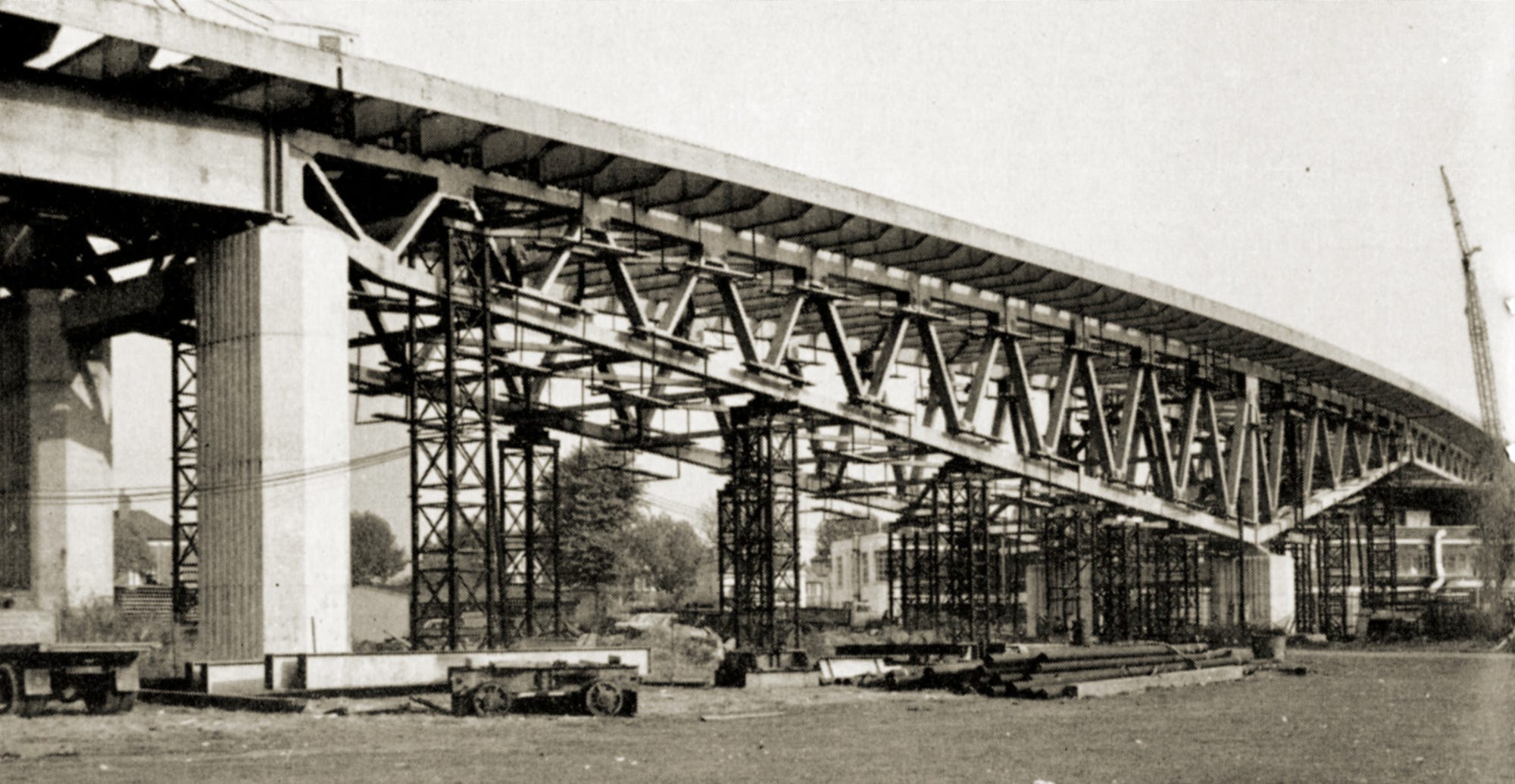
The other section was the difficult bit. After diverging from the Great West Road, the viaduct continues another kilometre before the motorway returns to ground level. Since this didn’t have to be suspended over another road, it could be built more economically, with simpler concrete columns supporting steel bridgework. But it also had to span a factory owned by Beecham’s (later GlaxoSmithKline, now GSK) where the sterile production line had to be kept dust-free.
The motorway jumps this obstacle with one long 111-metre span. Welders had to assemble its component parts in-situ, high above the factory roof, using entirely new techniques since this type of steel had never before been used in road or bridge construction.
The fact that the steelwork held up, the factory was untouched, and in three years of construction work no passing motorist had a lump of concrete or a spanner dropped on them from above, was the product of meticulous planning and discipline - since nobody doing the work had ever done it before.
New technology
A strange new road required strange new accessories.
The M4 between Chiswick and Heathrow was the first motorway to be illuminated, with tall columns planted down the central reservation in an attempt to improve safety on what was expected to be a busy urban route9. But that was only the start of the novel things installed on the new motorway.
The metalwork in the viaduct (in the form of steelwork and concrete reinforcement) meant that salting the road in cold weather would be a bad idea. Like many elevated roads in the 1960s, the M4 was equipped with a heating system, complete with sensors that would automatically switch it on when the temperature and humidity reached a certain level. It was, by some distance, the largest road heating system in the UK.
Electrical heating in 1964 was a brute force technology, designed for an era of exceptionally low energy prices. The total power consumption for the viaduct, when the system was switched on, was 8,000 kilowatts, so at the UK’s current electricity prices would cost about £2,000 per hour to run.
National Highways don’t have to worry about their electricity bill, though, because - in common with virtually every other road heating system installed in the 1960s - the heating under the M4 didn’t work for very long and has been out of use for decades. Instead the road is treated with a non-corrosive de-icer when the weather is cold. But these are a relatively new invention, and the years in which it was just salted like any other road are one of many reasons the viaduct is now in such an unhappy state.
The Ministry was also very concerned about traffic becoming trapped behind an accident or breakdown on the narrow viaduct, and took the unprecedented step of negotiating with the owners of nearby buildings to install CCTV cameras on rooftops all along the route. These were connected to a special new control room at Hounslow Police Station, along with 60 traffic detectors that would sense when traffic jams formed.
When problems occurred, the police officer monitoring the motorway could switch on “secret signs” at entrance points, indicating that the viaduct was closed and diverting traffic via the old A4 via Hounslow. When the system was devised in 1961 there was no other electronic monitoring or signalling system on a UK motorway, so it was yet another first10.
New thrills
The excitement over the new motorway was very real - it was entirely unlike anything else and transformed journeys to Heathrow11. The novelty of the new road was evident when the BBC’s Blue Peter sent their presenter Christopher Trace to drive out to Heathrow, marvelling at the new signs, CCTV cameras and the multi-storey airport car park.
Christopher Trace donned his stripy bobble hat to try out the M4 in 1965, when the motorway was still flowing freely. But that didn’t last long. As the novelty wore off, the traffic started to build up. Narrowing the motorway to two lanes for its final approach to London began to look like a mistake - and just seven years later the Layfield panel passed verdict, calling it “inadequate”.
By then it was too late. The bottleneck had been fixed in concrete and steel. London would have to live with it for generations to come.

In part 2…
We’ll find out exactly why the M4 was designed as a three-lane motorway that narrows down to a two-lane viaduct, and we’ll pay a visit to the meeting where nobody asked the one question that could have stopped it.
Picture credits
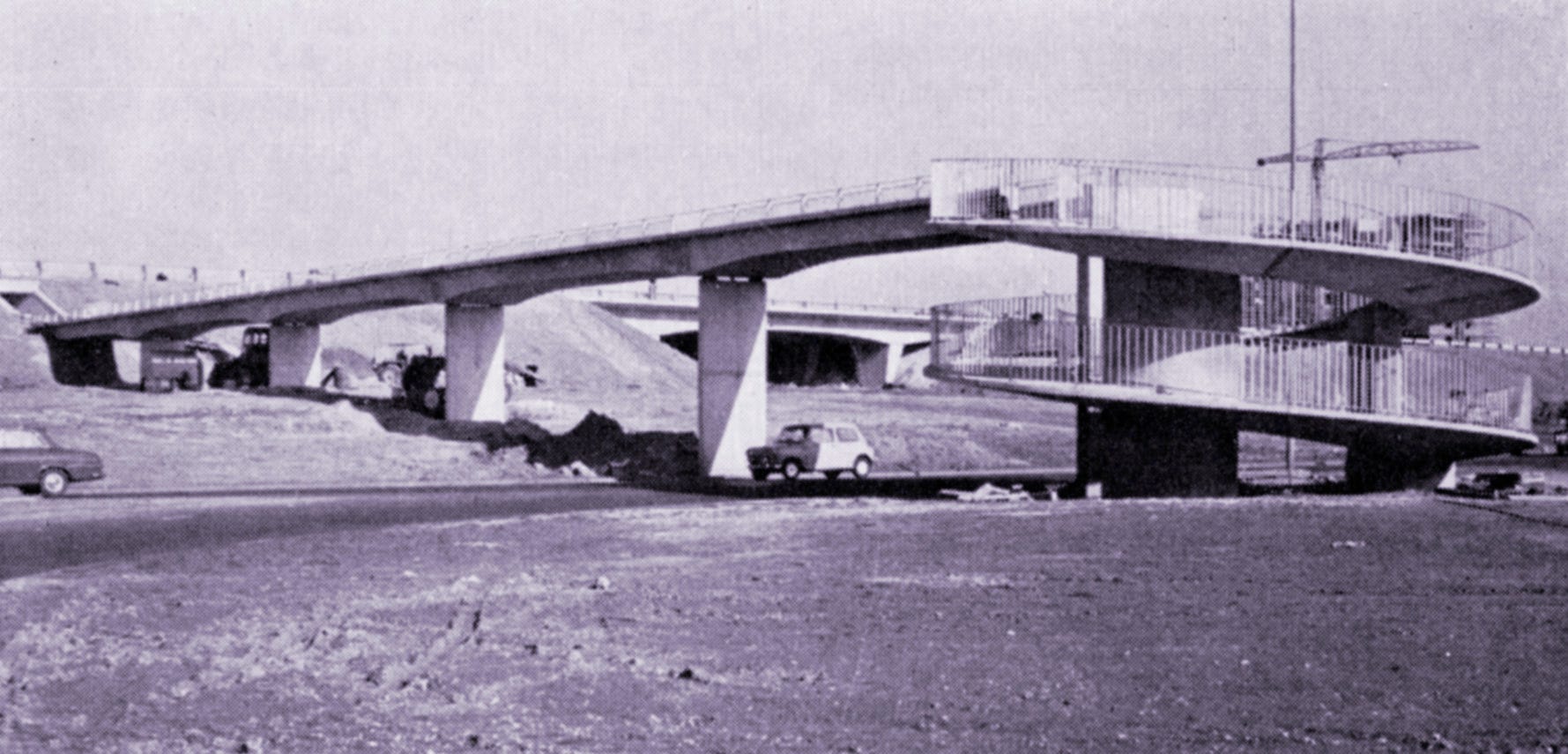
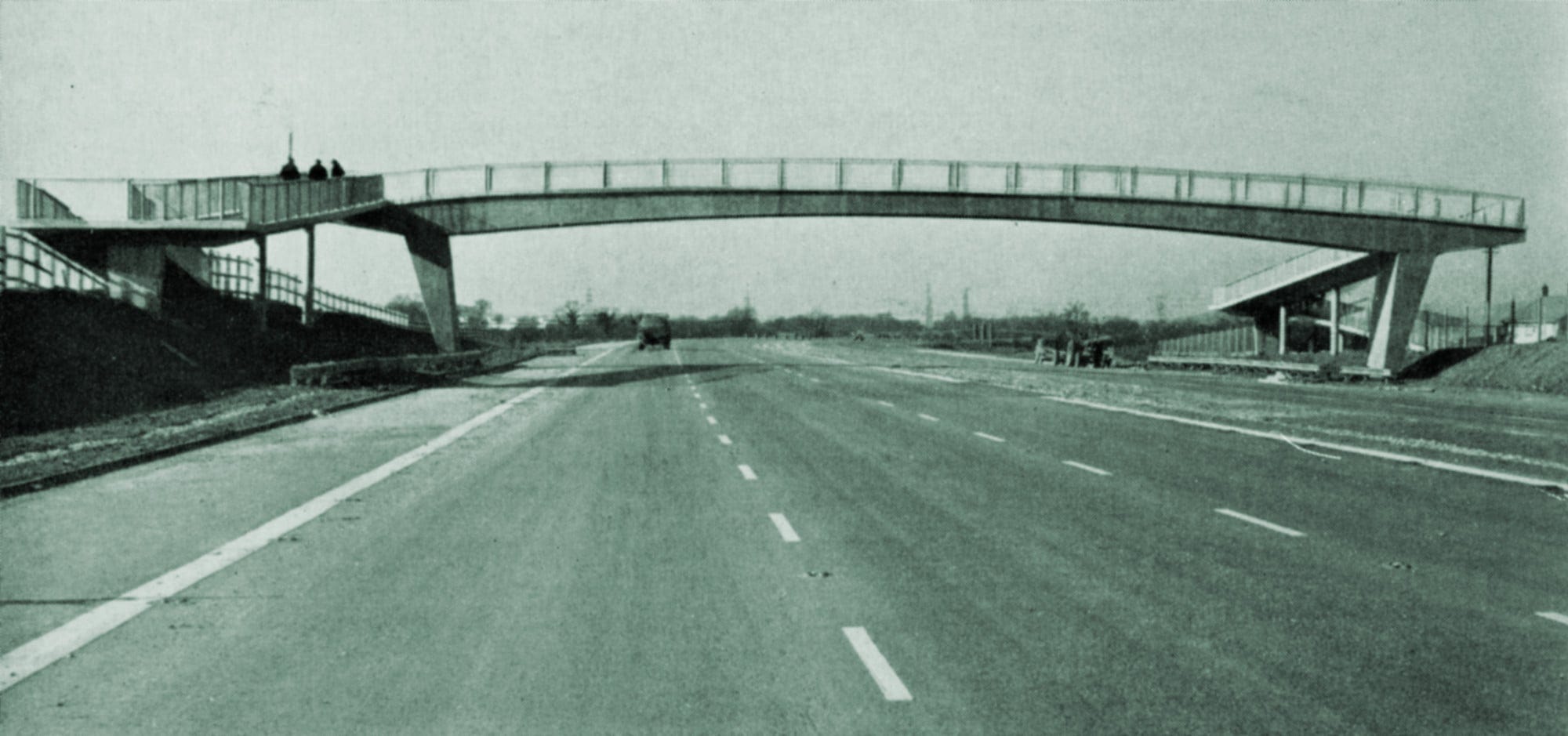
Map, and photographs of viaduct from above, Langley and Little Benty footbridges, the octopus and the steelwork at Boston Manor are taken from M4 Chiswick-Langley and London Airport, Ministry of Transport, 1965.
Photograph of Great West Road near Ealing Road is extracted from MT 95/726.
The above contain public sector information licensed under the Open Government Licence v3.0.
The public inquiry into the Greater London Development Plan, led by Frank Layfield, which was the longest and most contentious public inquiry in British history at the time. Among many other things it was the inquiry that passed judgement on the plans for London’s largely unbuilt urban motorway network.
Final draft of the report of the Greater London Development Plan Inquiry panel, Chapter XVII, page 28, as seen for example at HLG 159/626.
As above. The panel thought the only hope was to find another route to relieve it, at some distant time in the future, and far from the M4. They seemed to accept that this would probably never happen.
The technical term for lumps of concrete falling off is “spalling”. It’s the result of something pushing the concrete apart from the inside - maybe water that gets in through cracks and then freezes, or maybe the steel reinforcement rusting. It’s not quick, easy or cheap to fix.
“Special Roads” were created by the Special Roads Act 1949, which was the legal basis for motorways to exist in law. The term still applies to motorways now, but the underlying legislation has changed and the term is never used so publicly any more.
In the same era, NASA had a decade to learn how to do manned spaceflight and put a man on the moon. Over here our equivalent to the Apollo programme was to finish the M6 to Carlisle.
Long since covered with tarmac, just like most concrete motorways from the 1960s.
We now use rumble strips for this, thermoplastic material laid by a special machine that leaves frequent ridges that are noisy to drive over.
The UK’s first motorway, the M6 Preston Bypass, had lighting installed at its interchange with the A59 - but it was all removed before the motorway opened on the orders of the Minister of Transport, Harold Watkinson, who visited the site and decided it looked ugly.
This was particularly important because many passengers started their journey at the West London Air Terminal - essentially an airport terminal in Kensington. You could check in and go through customs there, then take an “airside” bus straight to your plane, a process that relied heavily on a fast road to Heathrow.
A brilliant read!