


I said I wouldn’t write while I was away this summer, and lined up a couple of posts to go out while I was gone, but I’ve written this anyway because it feels like exactly the sort of thing I’d write about if it was in the UK, and it would be a missed opportunity not to share it with you.
There’s no voiceover for this article since I’m writing it in a hotel room. Normal service resumes in the autumn.
This is a post about how we treat our heritage, and what counts as visual appeal in our cities, and how our measure of that may be quite different to that of other cultures. It’s also a post about a cool bridge I saw.
We often think that our cities have been rather battered about by ill-conceived regeneration and, worst of all, the dead concrete hand of the 1960s urban road project1. But British planners are usually very considerate of the urban environment, and even when history considers them to have got it badly wrong, the records show that they were at least trying to get it right. I’ve been through enough archive documents and minutes of civil service meetings to have seen first-hand that the intentions were always good even when the results were anything but.
The same probably applies in Japan, which I’m lucky to be visiting at the moment. Historic buildings and landmarks are preserved with great reverence here, but there are seemingly no barriers - legal, cultural or otherwise - against what you may erect beside or around them. The old must coexist with the new. Your immaculately preserved castle may have a bullet train passing just outside its fortifications; your ancient architectural treasure may be flanked by brand new glass office towers or three towering levels of electric railway infrastructure. But one place exemplifies this - and horrifies the visitor - more than any other.
The starting point
Not every country has a zero point for its road network (the UK doesn’t, for example, though you could be forgiven for thinking it does). But many do, and Japan is one of them.
The origin point of Japan’s road network is Nihonbashi Bridge, the first river crossing to be built (in 1603) when the capital of the empire was moved from the city of Kyoto to a little fishing town called Edo. Edo became Tokyo, and the bridge became its ceremonial centre point.
The physical bridge itself has been replaced on a number of occasions, and the present one dates from 1911, when a handsome stone arched bridge was erected, complete with fashionably European-looking ornamental balustrades and lanterns. It wouldn’t look terribly out of place in Paris or Vienna.
It stood in this way, surrounded by respectable and handsome nineteenth century buildings, until the 1960s, when Tokyo was host for the 1964 Olympics. In preparation the city’s transport network was overhauled, including the construction of a whole network of urban motorways.
The only way to build them quickly enough, in a city as dense as Tokyo, was to follow gaps in the urban fabric, so that property didn’t have to be acquired and buildings didn’t have to be cleared. And for a reasonable length of Shuto Expressway C1, that was achieved by building the road above the Nihonbashi River.
Pity the handsome bridge from 1911, which now stands underneath it.
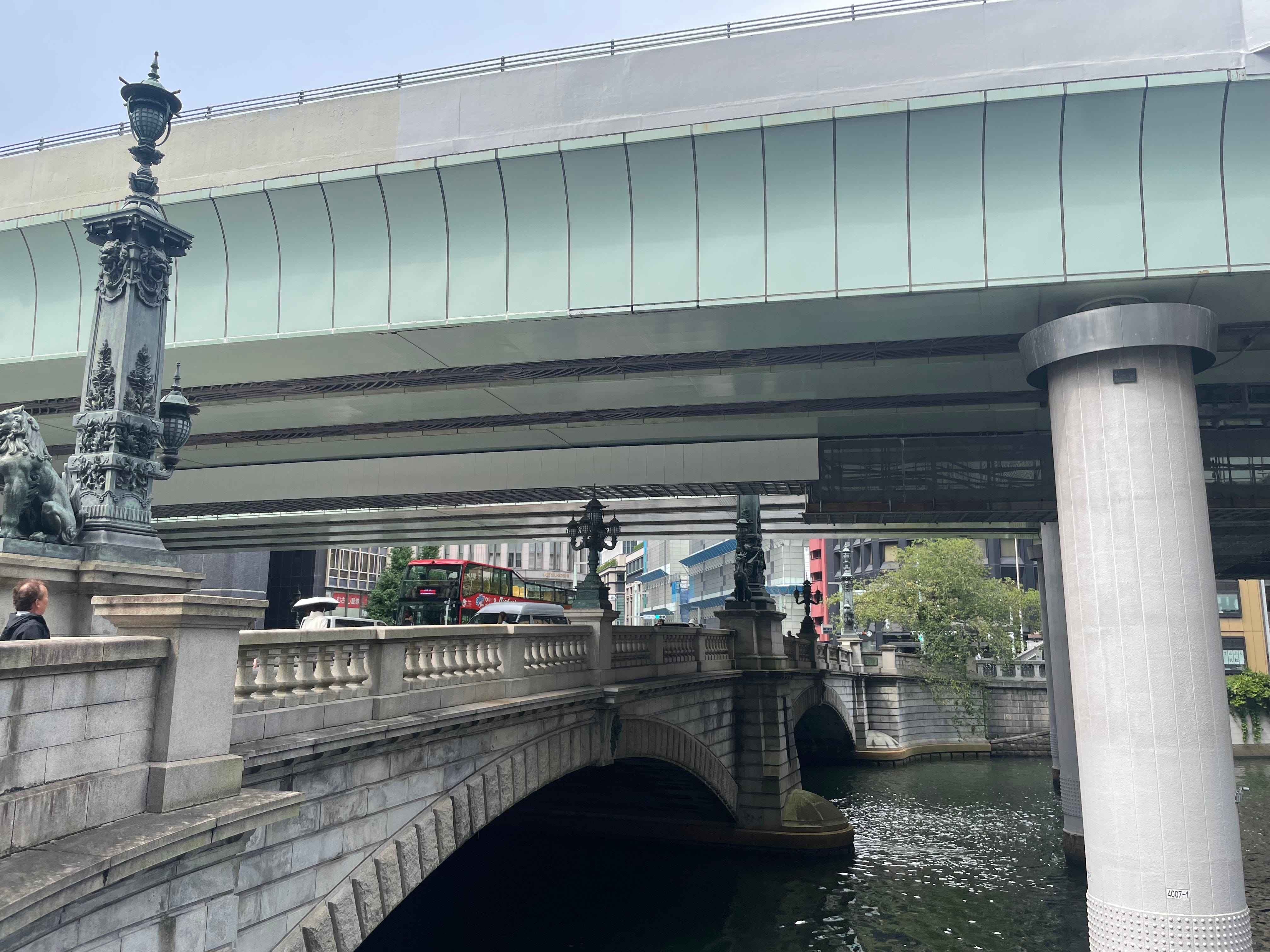
The view from down below
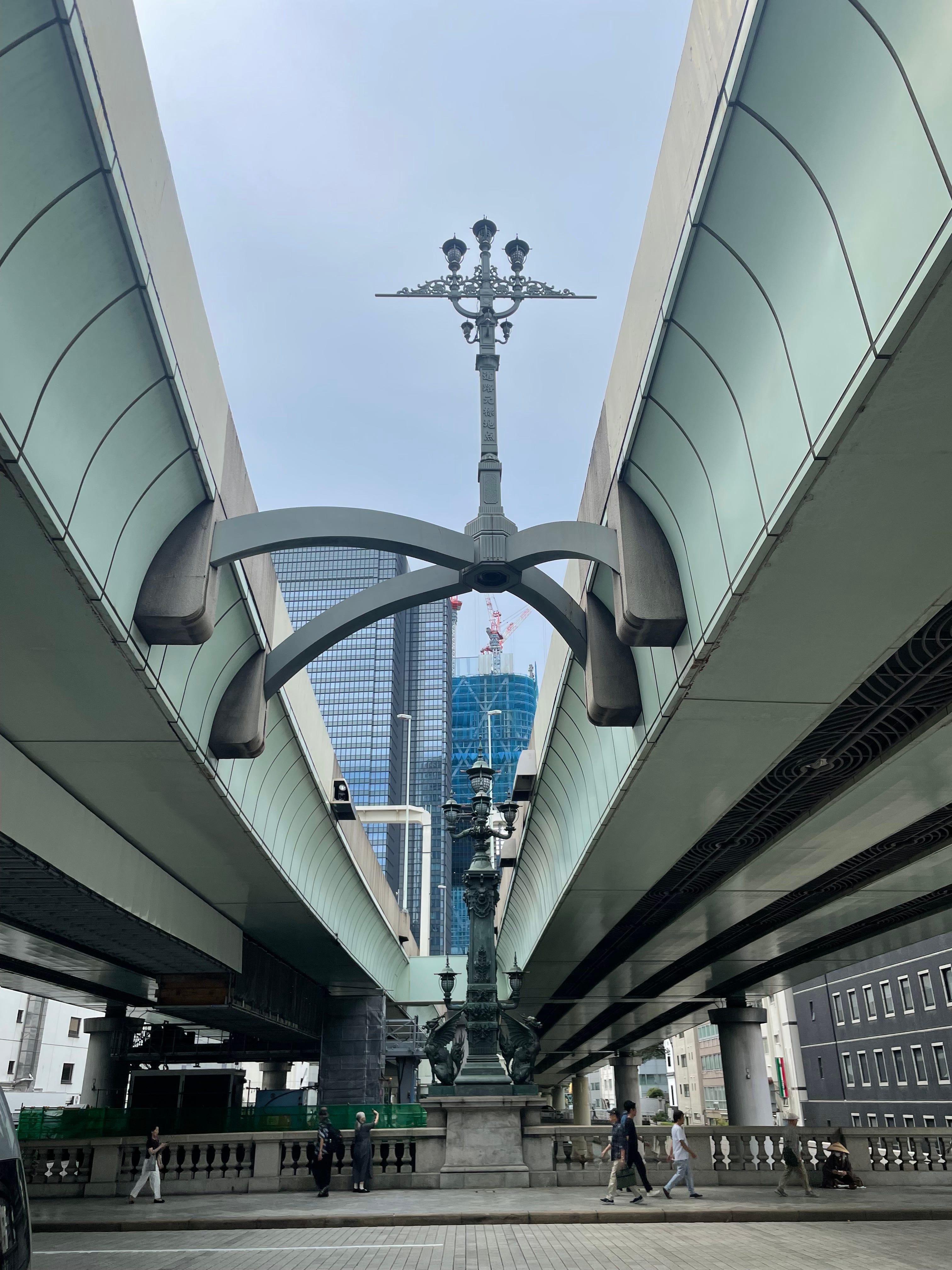
The sight of Nihonbashi Bridge is quite remarkable - it’s a thing entirely out of place now, with the expressway looming above it and the surrounding buildings redeveloped out of all sympathy. The viaducts that cross it are two separate structures, and the only concession to the older bridge’s existence is that the gap between the viaducts is positioned so that the lanterns at the centre of the bridge - which would be too tall to fit underneath - poke up between them, meaning they didn’t have to be decapitated. The bridge’s other lanterns happen to be shorter and so stand below the steel beams of the viaduct.


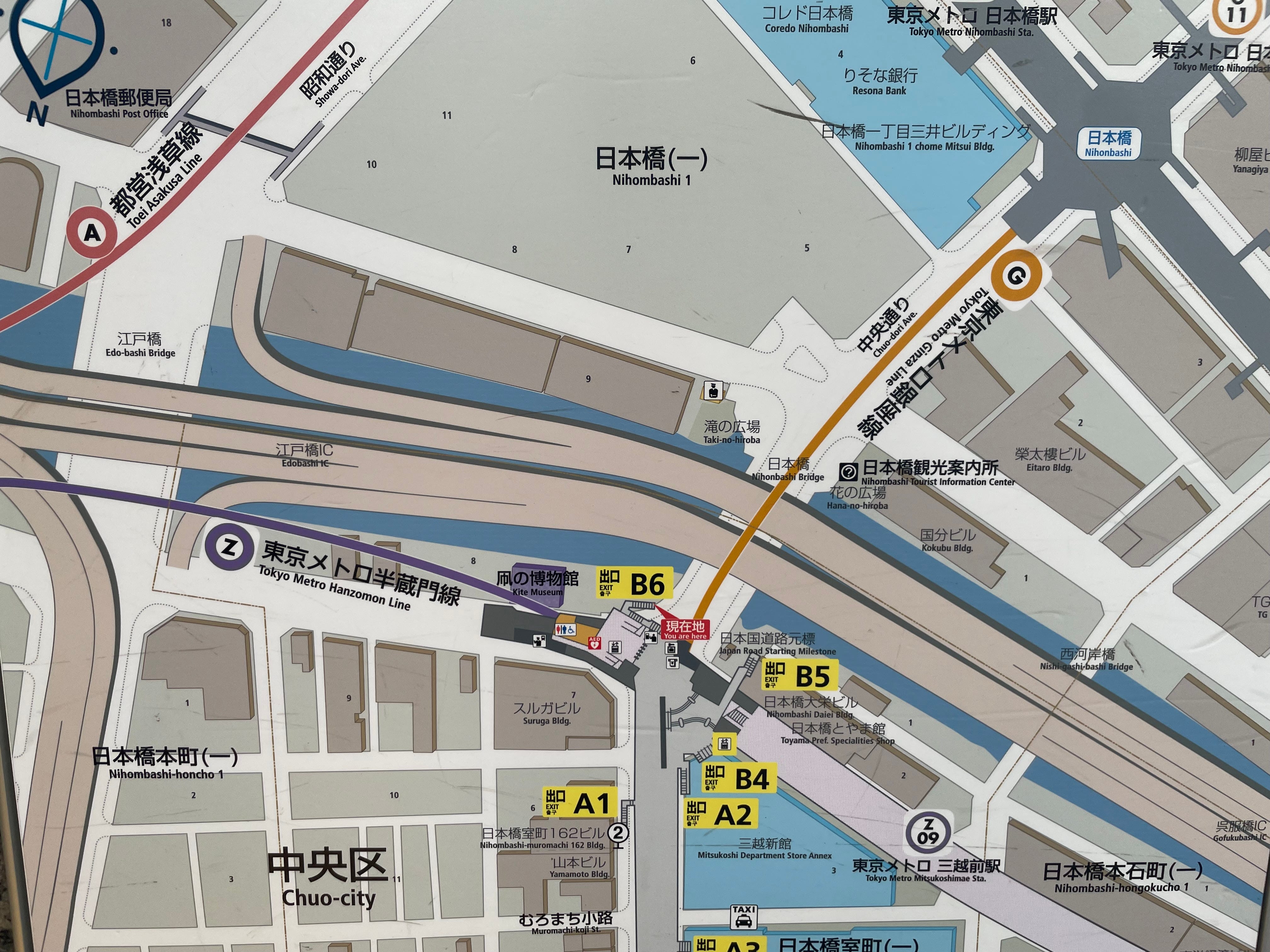
A nearby pedestrian map shows just how completely the expressway fills the river.
The view from the bridge, looking along the river, is also incredibly arresting - to cast the whole thing into shadow, indiscriminately planting support columns into the water so that they don’t even form lines or patterns, is surely the scrappy signature on this act of urban vandalism.


And yet, the people who designed this weren’t averse to the odd aesthetic flourish. When you pass over the top on the expressway, signs in both Japanese and English show a pictogram of a lantern and inform you that you’re at the zero point of the road network2, and a strange pastiche of the bridge’s ornate lanterns has been created and stands between the two viaducts, so that it’s visible to passing traffic on the motorway.
Tokyo isn’t blind to the scene this creates. Prompted by public protest, in the form of a petition of considerable size, a project is now under way to replace the overhead expressway with a tunnel, restoring the bridge to the open skies and enabling riverside walks and recreation.
Naturally this is a matter of great debate - would the city be better off just dismantling the viaduct and spending the equivalent billions of Yen on active travel or public transport instead? But Japanese cities seem to be quite firmly wedded to their urban expressway networks, so a replacement project it will have to be.
Tokyo’s Metropolitan Expressway company expects to be able to remove the viaduct in the early 2040s. Until then, Nihonbashi Bridge stands as a monument to the lessons Japan has learned and, indeed, the extremes we managed to avoid.
For examples of which, see my past writing on such sights as London’s Westway or Burdock Way in Halifax, among others.
The English wording is “The Starting Point of Road”, which is a little cryptic if you don’t already know where you are.
I think the bit we are missing here is THEY BUILT A BRIDGE ALONG A RIVER 🤯🤯🤯🤯🤯🤯 This is so bonkers I cannot wrap my head around it. Please tell me nowhere else has done something this bananas??!!
Those are quite sad ‘Westway’ style photos